Bangkok daily life · Payments
How Should You Pay in Bangkok: Cash, Cards, and QR?
Bangkok is highly digital, but not uniformly cashless. The reliable approach is a small payment system of your own: Thai QR when you can use it, cards where they make sense, and cash when neither behaves.
Reviewed July 31, 2026 · Later factual updates are dated within the guide
In this guide
Bangkok merchants may accept cash, cards, contactless payments, Thai QR payments, app payments, or only one of those methods. Access to Thai QR and PromptPay normally depends on an eligible participating account and app.
Carry more than one payment method, including a small amount of cash.
The short answer
| Situation | Usually the easiest option | Sensible backup |
|---|---|---|
| Street food or small market purchase | Cash or Thai QR | Small cash |
| Mall, supermarket, hotel, or hospital | Card, contactless, or Thai QR | Second card |
| Taxi | Cash, in-app payment, or driver QR | Exact or small cash |
| Motorcycle taxi or tuk-tuk | Agreed cash fare or QR when offered | Cash |
| Neighborhood restaurant | Thai QR, cash, or card where accepted | Cash |
| Online order or ride app | Saved card, Thai bank method, or app wallet | Cash on delivery where offered |
| Large purchase | Card or documented bank transfer | Confirm limits in advance |
Acceptance varies by merchant and payment provider.
Cash remains useful
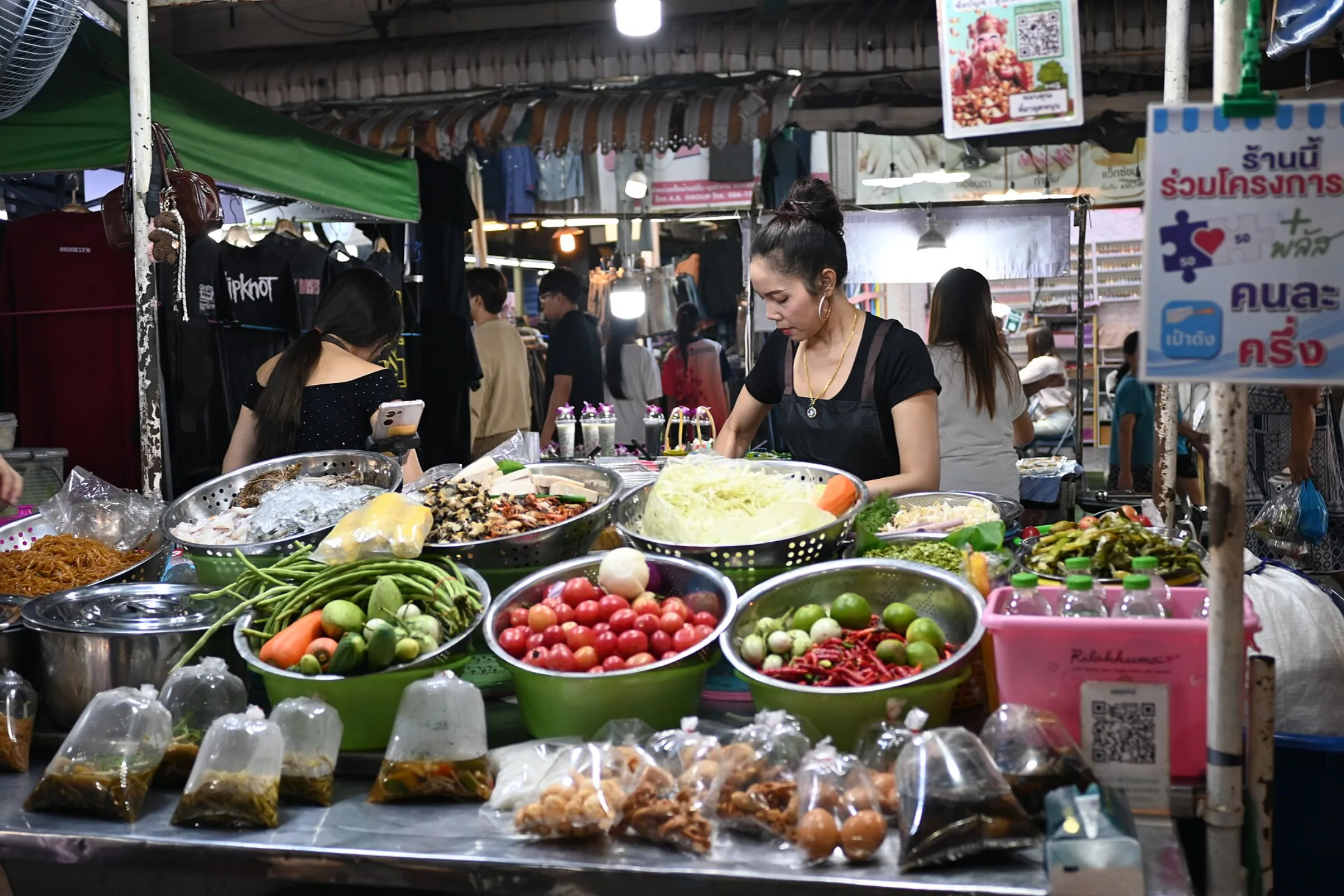
Cash is still normal for small food stalls, wet markets, older shops, motorcycle taxis, some tuk-tuks, tips, and any moment when a terminal or mobile connection fails.
Carry:
- ฿20, ฿50, and ฿100 notes for small purchases;
- enough for a taxi ride and simple meal;
- one larger emergency amount stored separately;
- coins if you regularly use buses, vending machines, or laundromats that require them.
Do not expect a vendor selling a ฿50 breakfast to break a ฿1,000 note at opening time. Ask politely, buy something larger, or get smaller notes from a supermarket or convenience store.
Cash also has a privacy and resilience advantage. It works during a bank-app outage, a dead phone, an expired SIM, or a card-security block.
Its weakness is obvious: lost cash is usually gone. Do not turn “cash backup” into walking around with a month of living expenses.
Thai QR is part of ordinary life
The Bank of Thailand describes Thai QR Payment as a service that lets users pay through a mobile-banking application. It operates through Thailand’s broader PromptPay infrastructure.
For someone with a compatible Thai bank account and mobile-banking app, QR can cover an enormous share of daily spending:
- coffee;
- meals;
- taxis and motorcycle taxis;
- market purchases;
- pharmacies;
- salons;
- repair services;
- rent and deposits;
- transfers between friends.
The process is usually simple:
- Open the payment or scan function in the bank app.
- Scan the merchant’s code.
- Enter the amount if it is not already embedded.
- Verify the recipient or merchant name.
- Confirm the payment.
- Show the success screen if requested.
Do not rush step four. A QR sticker can be replaced, covered, or linked to the wrong account. If the name on your phone does not match the merchant or person you expect, stop and ask.
A transfer success screen proves that money went somewhere. It is not always the same thing as an itemized receipt, tax invoice, rent receipt, or proof of what was purchased. Save the correct documentation when the transaction matters.
PromptPay access depends on your banking setup
PromptPay lets registered users transfer money through identifiers such as a mobile number, citizen identification number, or bank account. Thai QR uses compatible banking infrastructure to make merchant payments easier.
The important limitation is access.
Seeing a PromptPay or Thai QR sign does not mean any camera app, foreign banking app, or global payment wallet can pay it. A long-term resident with an active Thai bank account and working mobile-banking setup has a different experience from a visitor using only a U.S. checking account.
If you cannot open or maintain a Thai account, build your payment plan around cards and cash. Treat any cross-border QR access as a useful addition only after you have confirmed that your exact bank and app participate.
Cross-border QR works through specific links
Thailand has built QR-payment connections with participating financial institutions in several countries and jurisdictions. The Bank of Thailand’s May 2026 information includes links involving Cambodia, Malaysia, Vietnam, Singapore, Indonesia, Hong Kong, Laos, Korea, China, and other participating systems.
This does not create a worldwide QR network.
A Malaysian traveler may be able to scan a supported Thai merchant QR with a participating Malaysian bank app. A Chinese visitor may be able to use a supported Alipay, UnionPay, or WeChat Pay connection at participating merchant codes. The exact direction of service, bank, app, merchant acquirer, and transaction limit matter.
Most U.S. bank apps are not connected to Thai QR simply because they include a QR scanner.
Before depending on cross-border QR:
- check your bank’s current official support page;
- confirm that payments into Thailand are supported, not only outbound payments from Thailand;
- check transaction and daily limits;
- review the exchange rate and fee;
- test a small payment;
- carry another method.
Do not download an unfamiliar app because a social-media post claims it “unlocks PromptPay for foreigners.” Verify the provider, licensing, funding method, fees, identity requirements, and withdrawal process.
Cards work well in the formal economy
International credit and debit cards are commonly accepted at:
- major malls;
- supermarkets;
- hotels;
- private hospitals;
- chain restaurants;
- department stores;
- larger pharmacies;
- airlines and established travel businesses;
- many higher-end independent businesses.
Acceptance becomes less predictable at markets, small restaurants, local service businesses, taxis, and older independent shops.
Visa and Mastercard generally provide the broadest international-card usefulness. American Express can work at many hotels, malls, hospitals, and larger businesses, but acceptance is usually thinner at smaller merchants. Discover acceptance is less dependable.
Contactless payment can be convenient when the terminal and card support it. A phone or watch using a tokenized card may also work at a compatible contactless terminal. That does not mean Apple Pay, Google Pay, or another wallet is accepted as a named service everywhere. The underlying card, issuer permission, terminal, and merchant setup all have to cooperate.
Watch the screen before tapping. Confirm the amount in baht.
Pay in Thai baht unless you deliberately choose otherwise
A terminal or ATM may offer to convert the transaction into your card’s home currency. This is dynamic currency conversion, or DCC.
Visa says the offer should show:
- the amount in local and home currency;
- both currency symbols;
- the exchange rate;
- added fees or markup;
- a clear choice to accept or decline.
DCC gives you certainty about the home-currency amount, but the offered rate or markup may be worse than the conversion your card network and issuer would apply to a baht transaction.
For many travelers, choosing Thai baht and allowing the card network to perform the conversion is the better-priced option. Check your card’s foreign-transaction fee and conversion terms before treating that as an automatic rule.
If the merchant selects your home currency without consent, ask for the transaction to be cancelled and rerun in baht. Keep the receipt and contact your issuer if necessary.
Card surcharges and minimums vary
Some businesses impose a minimum card purchase, add a card charge, or accept cards only through one terminal or network. Practices can differ even between branches.
Ask before ordering or committing to a service:
- Do you accept this card?
- Is there a minimum?
- Is there a surcharge?
- Will the transaction be processed in Thai baht?
- Can you issue the receipt I need?
Do not assume the logo on a door guarantees that a terminal is working today.
For a large hospital, hotel, dental, or retail payment, contact the business in advance. Then confirm your issuer’s purchase limit, fraud controls, and whether the merchant may place a deposit or authorization hold.
Mobile wallets are useful, but fragmented
Thailand has bank apps, merchant apps, transit products, and electronic wallets. Some are easy for Thai citizens and established residents but difficult for a new foreign arrival because registration may require:
- a Thai phone number;
- local identity verification;
- passport review;
- a Thai bank account;
- a compatible card;
- an in-person step;
- a supported immigration status or document.
Requirements change. An app that accepted a foreign card last year may alter its funding options, and an account that works for purchases may not support transfers or withdrawals.
Use a wallet when it solves a recurring problem. Do not build a maze of balances across six apps because each one offered a coupon.
Foreign cards can fail for boring reasons
A declined payment does not always mean fraud.
Common causes include:
- issuer security controls;
- an international or online transaction block;
- an expired card;
- a damaged chip;
- a contactless limit;
- a merchant category restriction;
- a daily debit limit;
- an offline or poorly connected terminal;
- a name, billing-address, or one-time-password problem;
- a phone number that can no longer receive issuer verification messages.
Before moving, confirm how each issuer sends security codes and alerts. Keep access to your registered U.S. number if the issuer relies on it. Install the issuer app, record the international support number, and understand how to freeze and replace the card.
Do not keep both backup cards in the same wallet.
ATM withdrawals require two fee checks
The Thai ATM may charge a local operator fee for a foreign card. Your home bank may separately charge an out-of-network fee, international withdrawal fee, or currency-conversion cost.
Before accepting:
- read the operator fee;
- choose a withdrawal in Thai baht unless you intentionally accept DCC;
- check that the machine is attached to or clearly operated by a bank;
- shield the PIN;
- take the card, cash, and receipt;
- verify the account alert.
Fewer, larger withdrawals can reduce repeated fixed ATM fees, but they also increase the amount of cash exposed to loss or theft. Choose an amount that fits your actual spending and storage situation.
Never accept help from a stranger who approaches while you are using the machine.
Build a payment stack before you need it
A resilient setup might include:
- one primary credit card with no foreign-transaction fee;
- one backup card from a different issuer and preferably a different network;
- one debit card for ATM access;
- modest Thai-baht cash;
- a Thai mobile-banking and QR option if you qualify;
- access to your issuer apps and verification numbers;
- a separate emergency reserve.
Test each method before a medical appointment, rent due date, domestic trip, or large purchase.
Card rewards do not matter when the card is frozen and your backup is in the same locked account.
Verify every digital payment
Before approving a card, QR, wallet, or transfer transaction:
- confirm the amount;
- confirm the currency;
- confirm the recipient or merchant;
- look for an added tip, service charge, or conversion;
- keep the relevant receipt;
- check the bank alert afterward.
Use unique device and banking passwords. Enable biometric access and transaction alerts. Keep the phone operating system and banking apps current.
If a QR sticker appears to have been placed over another code, ask the merchant to confirm it. If a card terminal leaves your sight, request that it be brought to you or walk to the register.
Speed is convenient. Verification is cheaper.
Match the method to the consequence
For a ฿60 meal, convenience may matter most.
For rent, a condominium deposit, hospital bill, or expensive purchase, the payment trail matters just as much as the transfer:
- correct legal name;
- clear purpose;
- written amount and due date;
- bank or card confirmation;
- signed or itemized receipt;
- contract or invoice;
- refund and dispute terms.
The next guide covers paying rent and household bills in detail, including Wise, direct international transfers, Thai bank transfers, PayPal limitations, evidence, exchange rates, and landlord instructions.
Carry a charged phone, at least two cards, and a small amount of cash until local payment access is established.