Bangkok daily life · Wellness
What Do Massage and Wellness Cost in Bangkok?
Compare treatment type, provider qualifications, facilities, total price, and business standards.
Reviewed July 31, 2026 · Later factual updates are dated within the guide
In this guide
Bangkok massage services range from neighborhood shops and temple-school services to chains, hotel spas, and sports-focused practitioners. Prices, training, facilities, treatment type, and business standards vary.
Choose the treatment and setting first, then compare the total price and provider qualifications.
A current price snapshot
The following examples were checked on official provider websites on July 28, 2026. They are reference points, not standard Bangkok rates.
| Published service | Current listed price |
|---|---|
| Wat Pho Thai massage, 30 minutes | ฿340 |
| Wat Pho Thai massage, 60 minutes | ฿520 |
| Wat Pho Thai massage, 120 minutes | ฿1,040 |
| Wat Pho foot massage, 60 minutes | ฿520 |
| Wat Pho Thai massage with plai oil, 60 minutes | ฿620 |
| Wat Pho School Sukhumvit Thai massage, 60 minutes | from ฿380 |
| Wat Pho School Sukhumvit foot massage, 60 minutes | from ฿380 |
| Health Land foot massage, 60 minutes | ฿400 |
| Health Land Thai massage with herbal compress, 120 minutes | ฿1,050 |
| Health Land aromatherapy massage, 90 minutes | ฿1,200 |
| Health Land aromatherapy massage, 120 minutes | ฿1,500 |
Simple neighborhood shops may charge less. Premium day spas and luxury hotels can charge several thousand baht for a single treatment and considerably more for multi-hour packages.
Price follows location, setting, privacy, products, amenities, brand, and treatment length. It does not perfectly predict the skill of the therapist.
Thai massage is part of Thailand’s living culture
Traditional Thai massage, or Nuad Thai, is more than a tourist activity. It draws on knowledge and practices transmitted through generations, and UNESCO inscribed Nuad Thai on the Representative List of the Intangible Cultural Heritage of Humanity in 2019.
A traditional session commonly takes place clothed on a firm mat. It may include rhythmic pressure, compression, assisted stretching, and movement through different positions. Oil is generally not part of a basic traditional Thai massage.
Each therapist has an individual style. Some work gently and slowly. Others use more pressure and a stronger stretch. “Thai massage” on the menu does not guarantee one standardized sequence.
Tell the therapist:
- whether you want gentle, medium, or firm pressure;
- where you have pain, injury, numbness, recent surgery, or sensitive areas;
- whether you are pregnant;
- whether a position or stretch feels unsafe;
- which areas you do not want touched.
You are allowed to change your mind during the session. “Bao bao” is commonly used to ask for gentler pressure. A clear “stop” also works.
Foot massage is the easiest entry point
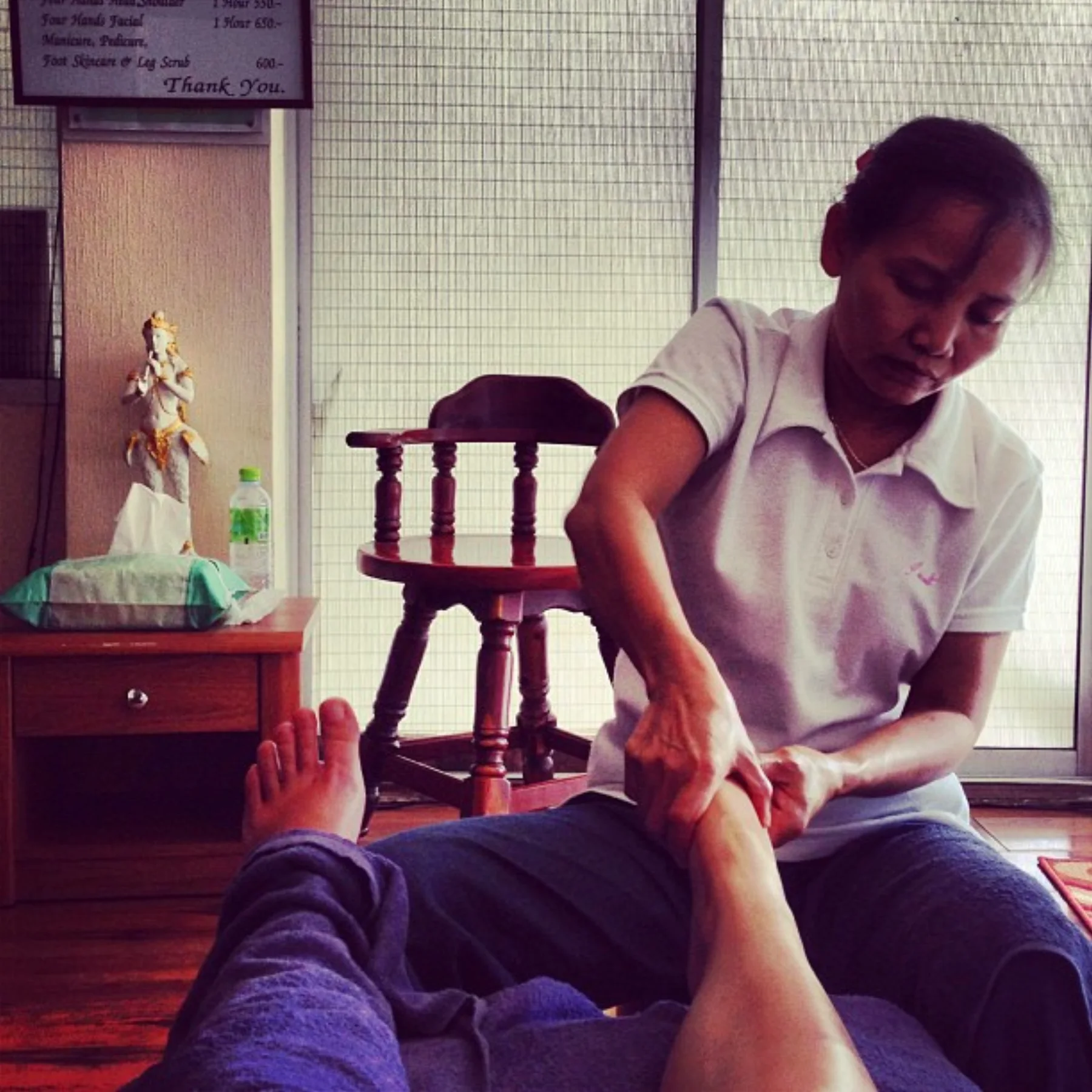
Foot-massage shops are common near offices, malls, transit, and residential neighborhoods. The treatment may include feet, lower legs, and sometimes a brief shoulder or head massage, depending on the shop and program.
It works well when you:
- walk extensively;
- want a clothed treatment;
- have limited time;
- prefer a shared room;
- are testing a new shop;
- do not want the stretching of a full Thai massage.
Shared rooms are normal in many practical massage businesses. Chairs may be close together, conversation may be audible, and the environment may be functional rather than silent. If you want privacy and spa quiet, ask about a private room or choose a provider designed around that experience.
Oil, aromatherapy, and spa massage are different experiences
Oil massage usually involves a private room, draping, and direct work on the skin. Aromatherapy services add scented oil or product choices and a more relaxation-focused setting.
Ask:
- what clothing is removed;
- how draping works;
- whether a shower is available;
- which oil or product is used;
- whether unscented products are available;
- whether the price includes tax;
- whether a private room is guaranteed;
- whether couples may book the same room.
If you have allergies or sensitive skin, request ingredient information and consider bringing a product you know you tolerate if the provider permits it. “Natural” does not mean reaction-proof.
Scrubs, facials, wraps, baths, and herbal compresses add time and cost. They can be enjoyable, but read the sequence. A four-hour package may contain transitions, shower time, refreshments, and rest periods as well as hands-on treatment.
Neighborhood shops can become part of real life
A good massage shop near home is one of Bangkok’s underrated daily-life advantages.
It can offer:
- easy walk-in service;
- straightforward pricing;
- therapists who learn your preferences;
- practical evening hours;
- value that makes regular visits realistic;
- a low-key environment without a full spa production.
Inspect the basics:
- visible price list;
- clean clothing, towels, and linens;
- orderly treatment spaces;
- clean foot-washing equipment;
- staff who ask about pressure and health concerns;
- a professional atmosphere;
- a clear service menu;
- no pressure to buy a large package.
Finding a favorite therapist matters. Record the person’s name or number if the shop uses one, and ask when they normally work. The same shop can deliver different experiences because massage is personal, physical work.
Established chains buy predictability
Large operators such as Health Land and Let’s Relax can be useful when you want recognizable booking systems, multiple branches, defined treatment menus, and a consistent professional environment.
Health Land’s current reservation information says its branches accept cash and Visa or Mastercard, with a ฿1,000 minimum for card payment. It asks clients to arrive fifteen minutes early and notify reception about high blood pressure, allergies, physical ailments, disabilities, and pregnancy. Its listed prices include VAT.
Those small details are what make an official menu useful. A service price without payment rules, arrival time, health disclosure, cancellation policy, or tax information is incomplete.
Even within a chain, branches differ. Room layout, noise, therapist availability, parking, and appointment demand can vary. Book the branch, treatment, and time you actually want rather than assuming the logo solves everything.
Wat Pho is both cultural landmark and practical reference
Wat Pho is deeply associated with Thai traditional medicine and massage. The temple’s official visitor information currently lists Thai and foot massage from thirty minutes to two hours, with service hours from 8 a.m. to 7:30 p.m.
The Sukhumvit branch of the officially recognized Wat Pho massage school publishes its own menu, including Thai massage, foot massage, shoulder and back massage, and herbal-ball programs.
For someone new to Thai massage, these services offer a useful reference point. They do not mean every therapist or visit will feel identical.
Temple etiquette still applies when visiting Wat Pho. Dress and behave respectfully in the temple complex, and separate the cultural visit from the assumption that the entire site exists as a spa backdrop.
Luxury spas sell time, space, and ceremony
At the upper end, Bangkok’s hotel and destination spas offer:
- elaborate private treatment rooms;
- high staff-to-guest service;
- premium products;
- baths, steam, sauna, or relaxation facilities;
- carefully designed arrival and tea rituals;
- multi-treatment programs;
- couples’ suites;
- highly controlled sound, scent, and lighting.

This is a different service and price category from a neighborhood Thai massage.
Check whether the listed price is net or subject to VAT and service charge. Confirm how early you may use the facilities, whether a treatment includes pool or fitness access, and whether the spa is inside the hotel or reached by a separate entrance or boat.
If you live in Bangkok, weekday and resident promotions can offer value. Read the blackout dates and eligible treatment list.
Onsen and bath facilities need their own etiquette
Bangkok has Japanese-style onsen and urban bath facilities, sometimes combined with massage, restaurants, lounges, or hotel stays.
Policies vary, but common issues include:
- gender-separated bathing areas;
- nudity in wet areas;
- washing before entering a bath;
- restrictions involving tattoos;
- health restrictions;
- age rules;
- time limits;
- no phones or photography;
- separate pricing for entry and treatment.
Read the facility’s rules before arriving. Do not assume that covering a tattoo, wearing a swimsuit, bringing a child, or entering during pregnancy is permitted.
Hot bathing can affect blood pressure and hydration. If you have cardiovascular disease, are pregnant, take relevant medication, or have another medical concern, obtain appropriate advice rather than treating an onsen as medically neutral.
Know when the problem needs medical care
Massage can feel relaxing and may help some people with ordinary tension or soreness. It does not turn a shop into a hospital.
Seek qualified medical assessment for:
- severe or unexplained pain;
- new weakness or numbness;
- chest pain or shortness of breath;
- fever or infection;
- acute injury;
- suspected fracture;
- significant swelling;
- persistent neurological symptoms;
- pain after a serious fall or accident.
Be cautious with businesses advertising that a routine spa treatment can cure disease, correct serious spinal conditions, remove “toxins,” or replace medical care.
When you need physiotherapy, rehabilitation, sports medicine, or pain management, look for the appropriately licensed healthcare service. A talented massage practitioner and a licensed physical therapist perform different roles.
Share relevant health information before treatment
Tell the provider about factors that may change the treatment:
- pregnancy;
- recent surgery;
- blood-clot history;
- uncontrolled blood pressure;
- osteoporosis;
- skin infection or open wounds;
- active cancer treatment;
- anticoagulant use;
- allergies;
- implanted devices;
- recent injections or procedures.
This is not a complete medical list. Ask your clinician when your situation is complex.
A professional provider should be willing to modify or decline a service. That protects both of you.
Professional boundaries should be obvious
Bangkok’s massage industry includes legitimate health-massage businesses, spas, traditional practices, and venues connected to adult entertainment. Neighborhood and street context can signal what kind of business you are entering, but appearances are imperfect.
If you want a straightforward wellness service, choose a provider with:
- a clear treatment menu;
- normal public reception;
- visible professional branding;
- transparent pricing;
- credible reviews describing the treatment;
- a calm explanation of health and booking policies.
You never owe agreement to a service you did not request. Leave if the environment feels wrong or the boundaries are unclear.
Thailand regulates health establishments and service-provider registration under its health-establishment framework. Government data also provides information on licensed health establishments. That does not eliminate the need to judge the specific premises and interaction.
How to communicate during the session
Do not endure painful pressure because you are trying to be polite.
Use simple instructions:
- gentler;
- stronger;
- avoid this area;
- no stretching;
- please stop;
- I am cold;
- the room is too warm;
- I need to sit up.
Pointing is fine. Translation apps are fine. A responsible therapist wants usable feedback.
Deep pressure is not automatically better. Pain does not prove that the treatment is effective. Intensity should match your comfort, health, and goal.
Tipping, payment, and booking
Tipping practices vary by venue, client, and service. It is common for satisfied customers to tip massage staff, but the amount is not a universal fixed percentage. Our separate Bangkok tipping guide addresses the issue in context.
Before treatment, confirm:
- cash, QR, and card acceptance;
- card minimum;
- price including VAT or service charge;
- deposit;
- cancellation and late-arrival policy;
- package expiration;
- whether the therapist receives gratuity directly;
- whether an online platform voucher covers the full service.
Keep some cash if you regularly use small neighborhood shops. Thai QR payment may require access to a participating Thai bank arrangement; do not assume a foreign banking app can scan every merchant code.
Packages require the same skepticism as gym contracts
A package is sensible only when:
- you already know the provider;
- you like more than one therapist;
- the branch is convenient;
- the savings are meaningful;
- the expiration is realistic;
- sessions can be rescheduled;
- closure and refund terms are clear.
Do not buy ten sessions after one good massage with one therapist unless you know what happens when that therapist leaves.
Save the receipt, package balance, written terms, and messages. Thailand’s Office of the Consumer Protection Board provides complaint channels, but good documentation is easier than reconstructing an agreement later.
Build a wellness routine that supports the rest of life
Massage should not become the only answer to poor sleep, an unsuitable desk, excessive drinking, chronic stress, or a training plan that keeps injuring you.
Use Bangkok’s wellness culture as one part of a healthier week:
- regular walking or exercise;
- reasonable sleep;
- hydration in the heat;
- time away from screens;
- medical and dental care;
- social connection;
- massage or spa visits you genuinely enjoy.

Choose a licensed or established provider, confirm the service and price, communicate health limitations, and maintain clear professional boundaries.
Official and provider sources
- Wat Pho official visitor and massage information
- Wat Pho School Sukhumvit branch information and prices
- Health Land official treatments, prices, and reservation terms
- Let’s Relax Spa official branch information
- Thailand government guidance on health-establishment service-provider registration
- Thailand government dataset on licensed health establishments
- UNESCO: Nuad Thai, traditional Thai massage
- Thailand Office of the Consumer Protection Board
Prices, hours, therapists, facilities, booking policies, and health guidance can change. Confirm the current service and discuss relevant health concerns before treatment.