Transportation · Bangkok
How to Get Around Bangkok
Compare rail, buses, boats, taxis, ride-hailing, walking, and motorcycles by route, time, weather, cost, and risk.
Reviewed July 31, 2026 · Later factual updates are dated within the guide
In this guide
Travel time in Bangkok varies by route, weather, hour, and the first and final sections of a trip. Rail is usually more predictable on covered corridors. Taxis and ride-hailing provide door-to-door access but are exposed to traffic. Buses and boats can be useful on specific routes. Motorcycle taxis can shorten some trips but involve materially higher road risk.
Most residents use several transport modes. Evaluate the complete trip rather than the distance to the nearest station.
The short answer
If you are new to Bangkok:
- Use the BTS and MRT as the backbone.
- Use metered taxis or an app-booked car when the destination is not near rail.
- Treat motorcycle taxis as a risk decision, not merely a shortcut.
- Use boats when the river or canal matches the route.
- Learn buses only after you understand the corridors you use repeatedly.
- Treat tuk-tuks as an occasional negotiated ride, not a serious commuting plan.
- Choose housing based on the trips you make every week and verify the walking route to the station.
A condo advertised as “near BTS” may still require a long or uncomfortable walk or an unreliable shuttle.
Start with the complete journey
Before choosing a neighborhood or signing a lease, list the places you expect to visit repeatedly:
- work or coworking;
- hospital and pharmacy;
- supermarket and market;
- gym;
- school or childcare;
- friends, partner, or family;
- airport;
- immigration or government offices;
- the part of the city where you actually spend your evenings.
Then test the routes at the times you will use them.
Google Maps can estimate a trip. It cannot tell you how the interchange feels with groceries, whether the station entrance has the elevator you need, or whether the sidewalk turns into a shin-deep puddle after heavy rain.
Measure door-to-door time under normal, rainy, late-night, and mobility-limited conditions. Distance to a station rarely tells the whole story.
BTS Skytrain
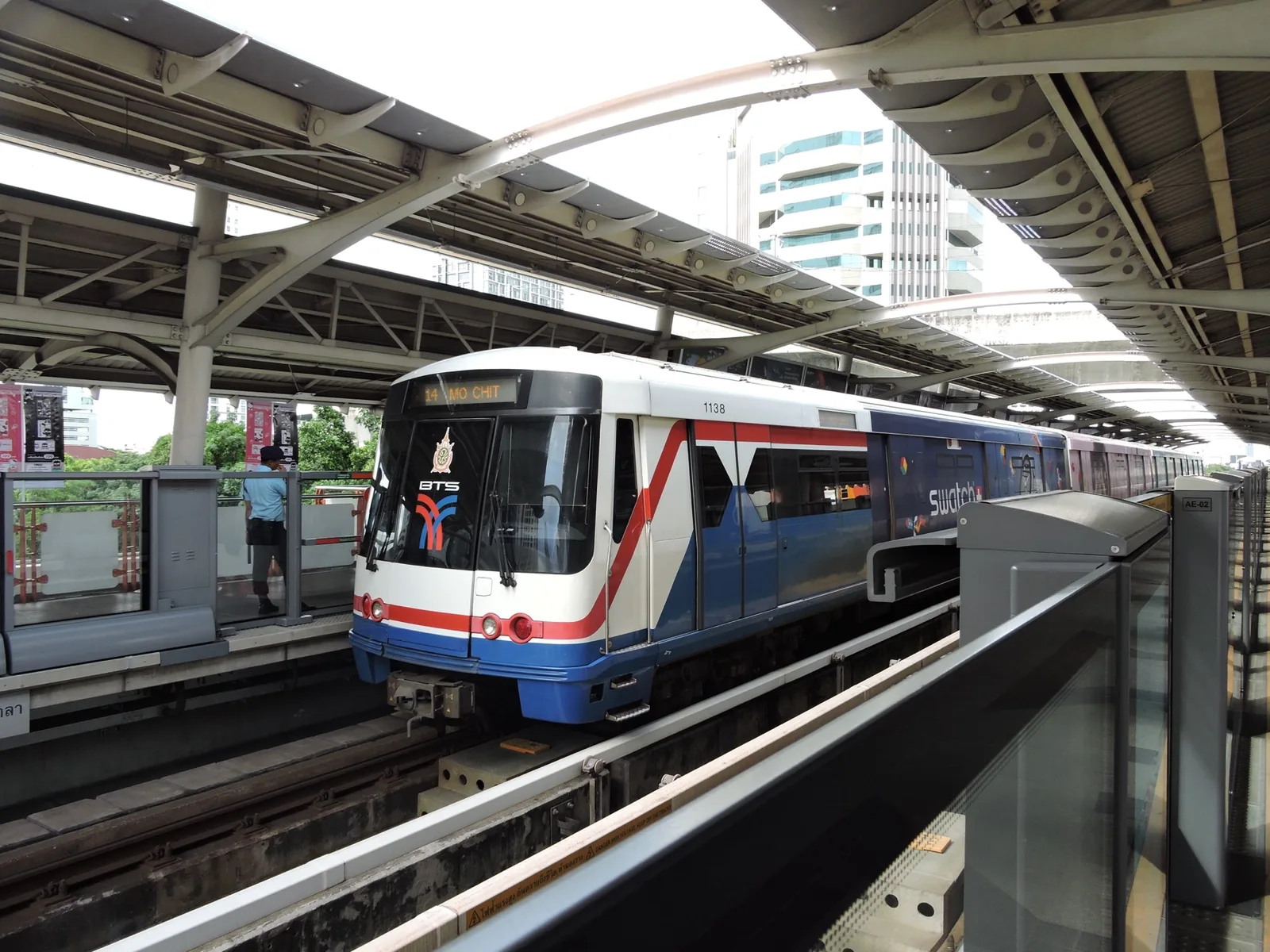
The BTS is the easiest system for many newcomers to understand. Its Sukhumvit and Silom lines connect a large share of the central areas where foreign residents work, shop, visit hospitals, and socialize.
It is fast when the alternative is road traffic. It is air-conditioned. Station names are announced in Thai and English. Transfers are straightforward once you have made them once.
It is also crowded at peak times, does not cover the entire city, and can become expensive when several people are traveling together.
Fares and payment
BTS fares are distance-based. The operator’s fare matrix effective November 1, 2025 shows adult Rabbit-card fares reaching 65 baht for longer trips that include extensions. Check the current official fare calculator or matrix before relying on a saved number.
For occasional use, buy a single-journey ticket at the station. For repeated use, a Rabbit card reduces the ritual of buying a ticket every time. Card issuance and activation requirements can change, so use the BTS instructions rather than an old blog post.
Do not assume one stored-value card works across every Bangkok rail system. Ticketing has improved, but the city is still capable of making “integrated transport” feel like a long-term aspiration.
When BTS works best
- Your home and frequent destinations are within a comfortable walk of stations.
- You travel along Sukhumvit, Silom, or a connected corridor.
- You want predictable travel time during road congestion.
- You do not need door-to-door assistance.
Where the BTS becomes less useful
- The station walk is long, exposed, or difficult.
- Your route requires several paid transfers.
- You are traveling with multiple people, luggage, a stroller, or limited mobility.
- The destination sits deep inside a soi.
- You are traveling after service ends.
MRT
The MRT Blue Line is especially useful because it forms a large loop through central and older Bangkok, with access to areas such as Sukhumvit, Silom, Chinatown, the old city edge, Chatuchak, and major interchange points. The Purple Line extends the network northwest.
The MRT may be the better housing anchor when your daily life is around Asok, Rama 9, Ratchada, Silom, Sam Yan, Chinatown, Bang Sue, or the river side of the old city.
Contactless payment
BEM states that eligible contactless credit cards issued by Thai or international banks can be used on the Blue and Purple lines. Its current instructions include Visa and Mastercard, with specified UnionPay products. Eligible debit-card rules are narrower and change by issuer.
Use the same physical card to tap in and out. If you enter with one card and exit with another, the system may treat the journey as incomplete and charge the maximum applicable fare.
A phone wallet and the physical card behind it may not be treated as the same credential. When the gate is involved, cleverness is usually less efficient than tapping the same card twice.
Single-journey tokens and MRT card products remain available. Check BEM’s current ticket page for the latest rules and fare calculation.
Airport Rail Link
The Airport Rail Link connects Suvarnabhumi Airport with central Bangkok through stations including Makkasan and Phaya Thai.
It can be good when:
- traffic is heavy;
- you are traveling light;
- your destination connects cleanly to the BTS or MRT;
- you arrive during operating hours.
It can be miserable when:
- you have large luggage;
- the transfer requires stairs, long walks, or another car ride;
- you are injured or mobility-limited;
- you arrive with children after a long flight;
- the final destination is not actually near the connecting station.
Rail is not automatically more virtuous than a taxi. A person with two suitcases and a bad knee does not win a medal for changing trains at rush hour.
Metered taxis
Bangkok taxis are abundant, inexpensive relative to many global cities, and genuinely useful. They are also the source of a disproportionate amount of newcomer drama.
A licensed metered taxi should use the meter for an ordinary street-hailed trip. Tolls are separate. Airport procedures and surcharges are separate. If the driver proposes a flat price, you can accept, negotiate, or decline. The practical answer is often to close the door politely and try again.
Do not begin the ride and then conduct a courtroom cross-examination over twenty baht. Confirm the destination, confirm the meter, and leave if the arrangement is not acceptable.
Carry the destination in Thai, ideally with a nearby landmark. Bangkok contains repeated street names, long sois, one-way segments, and buildings whose English names sound nothing like the way a driver knows them.
A metered taxi is often best for
- two or more passengers;
- luggage;
- late-night travel;
- door-to-door hospital access;
- destinations poorly served by rail;
- days when heat or rain makes the station walk unrealistic.
Common friction
- refusal during rush hour, rain, shift change, or for an unattractive destination;
- confusion about pickup points;
- tolls not included in the meter;
- drivers who do not know a new condominium or English business name;
- traffic that turns a short map distance into a long relationship.
Most rides are ordinary. Build a backup rather than assuming every refusal is a national emergency.
Grab and other ride-hailing apps
Grab is useful because the app records the pickup, destination, driver, route, and payment trail. It also reduces the language problem.
Grab currently offers different service types. GrabTaxi generally combines a metered fare with a booking fee. JustGrab shows an upfront fare and may assign a taxi or private car. The available products, fees, and payment methods can vary by location and demand.
Check the service shown on the booking screen. “Taxi” and “fixed fare” are not interchangeable merely because both vehicles have four doors.
Other apps may quote less. Lower price does not guarantee faster pickup, better driver availability, or the same support and safety features. Compare the actual trip when it matters.
App-booking mistakes
- Dropping the pin inside a building rather than at the vehicle entrance.
- Waiting on the opposite side of a divided road.
- Assuming the estimate includes tolls or parking.
- Booking before you can physically reach the pickup point.
- Ignoring the driver’s plate and vehicle details.
- Expecting instant pickup during rain.
Grab publishes tools including trip sharing, driver identification, emergency support, and in-app safety reporting. Use them. A safety feature buried in a menu is not useful if you first discover it while something is going wrong.
Motorcycle taxis and app-booked motorbikes
Motorcycle taxis solve a real Bangkok problem. They move through traffic and handle the last kilometer of a deep soi better than almost anything else.
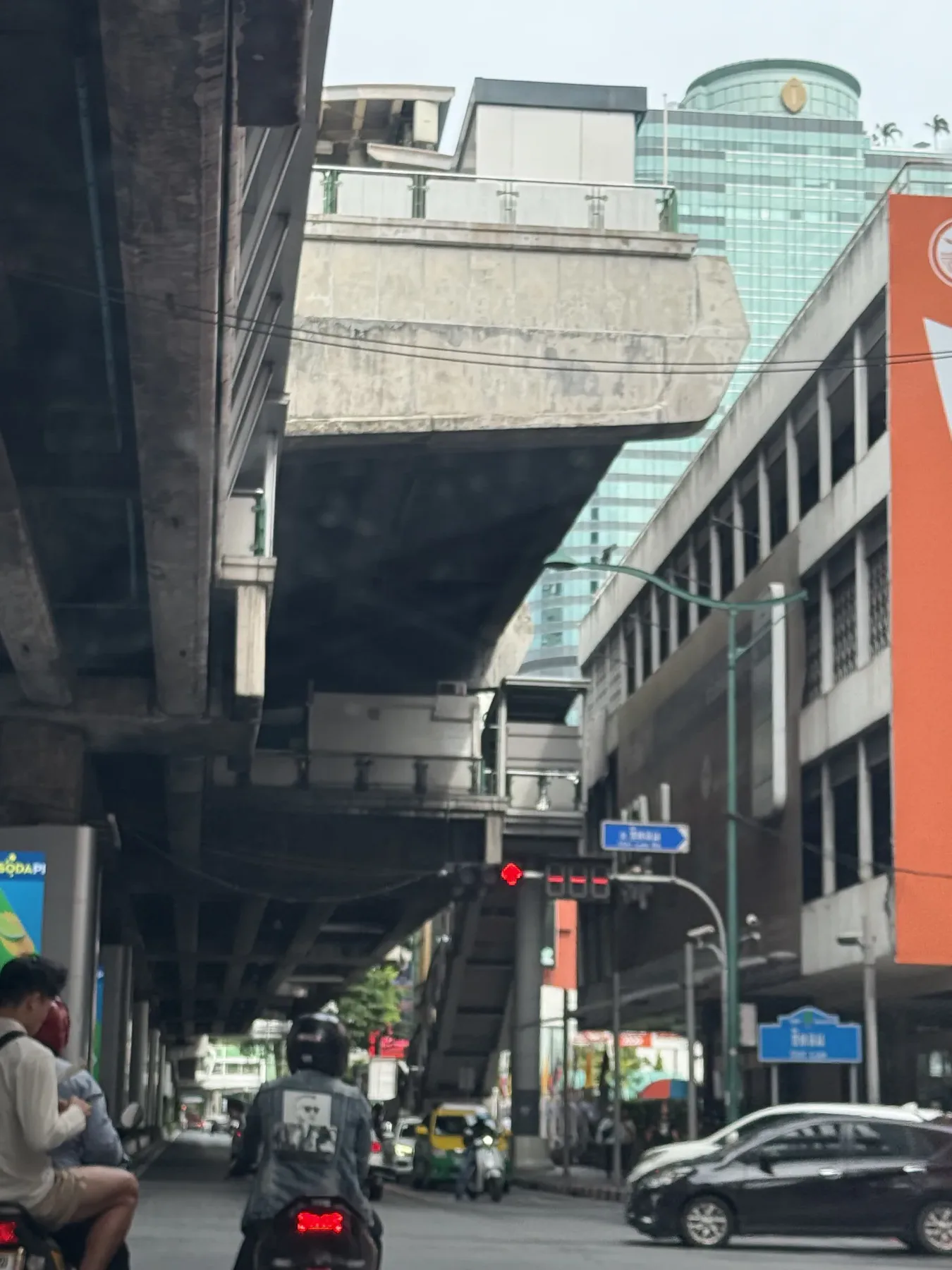
They also expose you to a real Bangkok risk.
The World Health Organization’s Thailand road-safety profile reports a national motorcycle helmet law for drivers and passengers, but the observed wearing rates in the profile are far from universal. A legal requirement is not the same as a safe ride.
Before using a motorcycle taxi:
- insist on a proper helmet;
- confirm the fare before a street-hail ride;
- use the app record when booking digitally;
- avoid carrying awkward luggage;
- do not ride if the driver appears impaired or reckless;
- do not let urgency make the safety decision for you;
- check whether your insurance covers motorcycle injuries and under what license conditions.
Motorcycle taxis are common, useful, and culturally normal. None of that changes the physics.
For some residents, they are a daily tool. For others, the risk is unacceptable. Both choices carry transportation consequences.
Tuk-tuks
Tuk-tuks provide short-distance transport, but tourist-area fares may be high and are normally negotiated.
There is generally no meter. Agree on the price and destination before boarding. Do not accept an implausibly cheap sightseeing ride tied to stops at shops, tailors, gems, or “special” attractions.
For a short ride with a clear price, a tuk-tuk can be fun and occasionally practical. For a daily commute, it is noisy, exposed to pollution and weather, and usually poor value compared with rail, a metered taxi, or an app-booked ride.
Ride one because you want to. Do not build a housing decision around it.
Buses
Bangkok buses reach places the rail network does not. They are cheap and can be good once you know a route.
The learning curve is the problem.
Routes may have variations. Traffic destroys timetable precision. Stops can be hard to identify. Vehicle quality and air-conditioning vary.
Start with one repeated corridor rather than trying to master the entire network. Use a current route-planning app, verify the bus number and direction at the stop, carry small cash until you know the accepted payment on that service, and ask the conductor when uncertain.
Buses can eliminate an awkward rail transfer, but congestion can make journey times long and unpredictable.
River boats, canal boats, and ferries
Bangkok’s waterways are useful when your origin and destination align with them.
The Chao Phraya Express Boat serves piers along the river. Cross-river ferries connect opposite banks. The Saen Saep canal boats cut across parts of central Bangkok.
Boats can bypass road congestion and make river districts much more practical. They can also involve:
- steep or moving boarding surfaces;
- splashing;
- limited accessibility;
- service-hour and weather constraints;
- pier names that are unfamiliar at first;
- a final walk or transfer.
Check the official operator’s current route, flag, hours, and fare before traveling. Tourist boats and regular services may use different fare structures and stopping patterns.
The river is not a decorative blue line on the map. For the right household, it is public transportation.
Walking
Bangkok is walkable in fragments.
A neighborhood may have good food, pharmacies, cafés, and a station within one kilometer. That does not mean the kilometer is pleasant.
Test:
- sidewalk continuity;
- crossings;
- shade;
- construction;
- motorcycle traffic on pedestrian space;
- drainage after rain;
- lighting at night;
- elevator and escalator access;
- the route while carrying groceries.
Heat changes walking distance. So does age. So does a child. So does a knee that behaved perfectly during the property viewing.
The correct question is not “Is this neighborhood walkable?” It is “Can the people in this household comfortably complete the trips they need to make?”
Driving and parking
A private car provides control, air-conditioning, child-seat options, and easier access to parts of Bangkok outside the rail core. It also creates parking costs, traffic exposure, maintenance, insurance, and the need to drive in an environment that may be unfamiliar.
Before buying or leasing a car, check:
- parking included with the home;
- parking at work, school, hospital, and frequent destinations;
- flood exposure on normal routes;
- toll-road use;
- legal license requirements;
- insurance and permitted drivers;
- whether a taxi budget would cost less than ownership.
For the broader ownership decision, read Can You Live in Thailand Without a Car or Motorcycle?. It compares locations across Thailand and explains the role and limits of an International Driving Permit.
What transportation really costs
Do not compare only the rent.
A cheaper apartment far from rail may require:
- two motorcycle rides every workday;
- frequent app-booked cars;
- longer hospital trips;
- food delivery because groceries are inconvenient;
- a private car and parking;
- hours of unpaid commuting.
A more expensive home beside a useful station can be cheaper after transportation and time are included. The reverse can also be true for a household that rarely enters central Bangkok.
Build a monthly transportation estimate with:
- rail trips;
- first- and last-mile rides;
- taxis and ride-hailing;
- airport trips;
- tolls;
- parking;
- occasional rentals;
- vehicle ownership, if applicable;
- the cost of transporting visitors or family members independently.
Then price your time. Not with a fake spreadsheet wage for every minute of life, but honestly enough to notice when saving 4,000 baht in rent creates twenty extra hours of commuting.
A practical transport hierarchy
For many central-Bangkok residents:
Rail first. Use BTS or MRT for the predictable long segment.
Walk when the route is genuinely comfortable. Not when a property listing says it should be.
Use a car for the awkward trips. Rain, luggage, hospitals, groups, late nights, and destinations outside rail corridors.
Use motorcycle taxis only after making a conscious risk decision.
Use boats when geography makes them efficient.
Learn buses route by route.
Use tuk-tuks selectively, with the fare agreed first.
Use this hierarchy as a starting point, then test it against your own routes.
The seven-trip housing test
Before signing a Bangkok lease, make these trips from the building:
- Morning trip to work or your main daytime destination.
- Evening return during peak traffic.
- Grocery trip with bags.
- Hospital trip.
- Late-night trip after rail service.
- Rainy-day trip, if the weather cooperates.
- Airport trip with realistic luggage.
Record the door-to-door time, walking conditions, transfer count, cost, and how you felt at the end.
Housing amenities do not offset repeated transport delays. Record the complete journey before choosing a building.
Learning the correct pickup points, station exits, and transfer routes can reduce delays.
Last reviewed: July 31, 2026. Fares, routes, operating hours, and payment systems change; confirm current details with the operator.
Editorial disclaimer: General educational information. Fares, operating hours, payment rules, routes, app services, and legal requirements change. Verify consequential details with the responsible operator or authority before relying on them.
Official and operator sources
- BTS: routes and fare information
- BTS adult Rabbit-card fare matrix effective November 1, 2025
- BTS: Rabbit card issuance
- BEM Bangkok MRT: route, fare, and service information
- BEM: EMV contactless payment
- Department of Land Transport
- Grab Thailand: GrabTaxi
- Grab Thailand: JustGrab
- Grab Thailand: trust and safety
- WHO: Thailand road-safety profile