Bangkok daily life · Climate
What Are Bangkok’s Weather, Air Quality, and Flooding Really Like?
Plan housing, transport, exercise, and indoor air around heat, heavy rain, localized flooding, and poor-air periods.
Reviewed July 31, 2026 · Later factual updates are dated within the guide
In this guide
Bangkok’s heat, humidity, heavy rain, localized flooding, and air pollution affect housing, transport, health, and outdoor activity.
Inspect the walking route, drainage, ventilation, air-conditioning, building access, and indoor-air options before signing a lease.
The practical version of Bangkok’s seasons
Thailand’s Meteorological Department broadly describes three seasons for upper Thailand:
| Period | What Bangkok life often feels like |
|---|---|
| Roughly mid-February to mid-May | Hot season, with April commonly among the hardest months |
| Roughly mid-May into October | Southwest-monsoon period, with frequent thunderstorms and uneven heavy rain |
| Roughly November to mid-February | Drier, often more comfortable mornings and evenings |
These are patterns rather than appointment times. The official start of the rainy season changes by year. Rain can arrive in the hot season. Heat and humidity continue through much of the year. A “cool” Bangkok morning does not resemble winter in Chicago.
The Thai Meteorological Department announced the 2026 rainy season beginning on May 15. Its monthly reports also show why one label cannot describe every month: May brought widespread rain, while June rainfall was uneven and below normal in several regions even though the southwest monsoon remained active.
Use current forecasts for current decisions. Use seasonal patterns for housing and lifestyle decisions.
Heat changes the value of distance
Bangkok heat is physical.
It affects:
- how far you willingly walk in work clothes;
- whether you arrive at a meeting presentable;
- how often you use motorcycle taxis or ride-hailing;
- electricity consumption;
- when you exercise;
- how much time children or older relatives can comfortably spend outside;
- whether a balcony or rooftop area is genuinely usable.
A map may show a 700-meter walk. The lived version may include full sun, uneven pavement, road crossings, construction dust, and no shade.
Test a possible home at 2 p.m. Walk to the station, supermarket, pharmacy, and nearest place where you would regularly eat. Return carrying groceries.
Then test it again after dark.
Buildings connected to rail, malls, covered walkways, or mixed-use developments can command a premium because they remove difficult outdoor minutes. That premium may be worth more to you than extra floor space farther down a soi.
Build a heat routine
Bangkok residents adapt with timing and redundancy:
- exercise early or after sunset;
- keep water available;
- use breathable clothing;
- plan indoor stops on long walks;
- carry sun protection;
- avoid scheduling every errand in the hottest part of the day;
- keep a ride-hailing backup;
- learn which station exits have escalators, elevators, or covered links.
People with medical conditions, older adults, pregnant people, and families with young children should discuss heat exposure with an appropriate clinician. Severe weakness, confusion, fainting, or other signs of heat illness require prompt medical attention.
Air conditioning deserves inspection before a lease is signed. Run every unit. Listen for noise. Check cooling, drainage, filter condition, and the position of outdoor compressors. Ask who pays for cleaning and repairs.
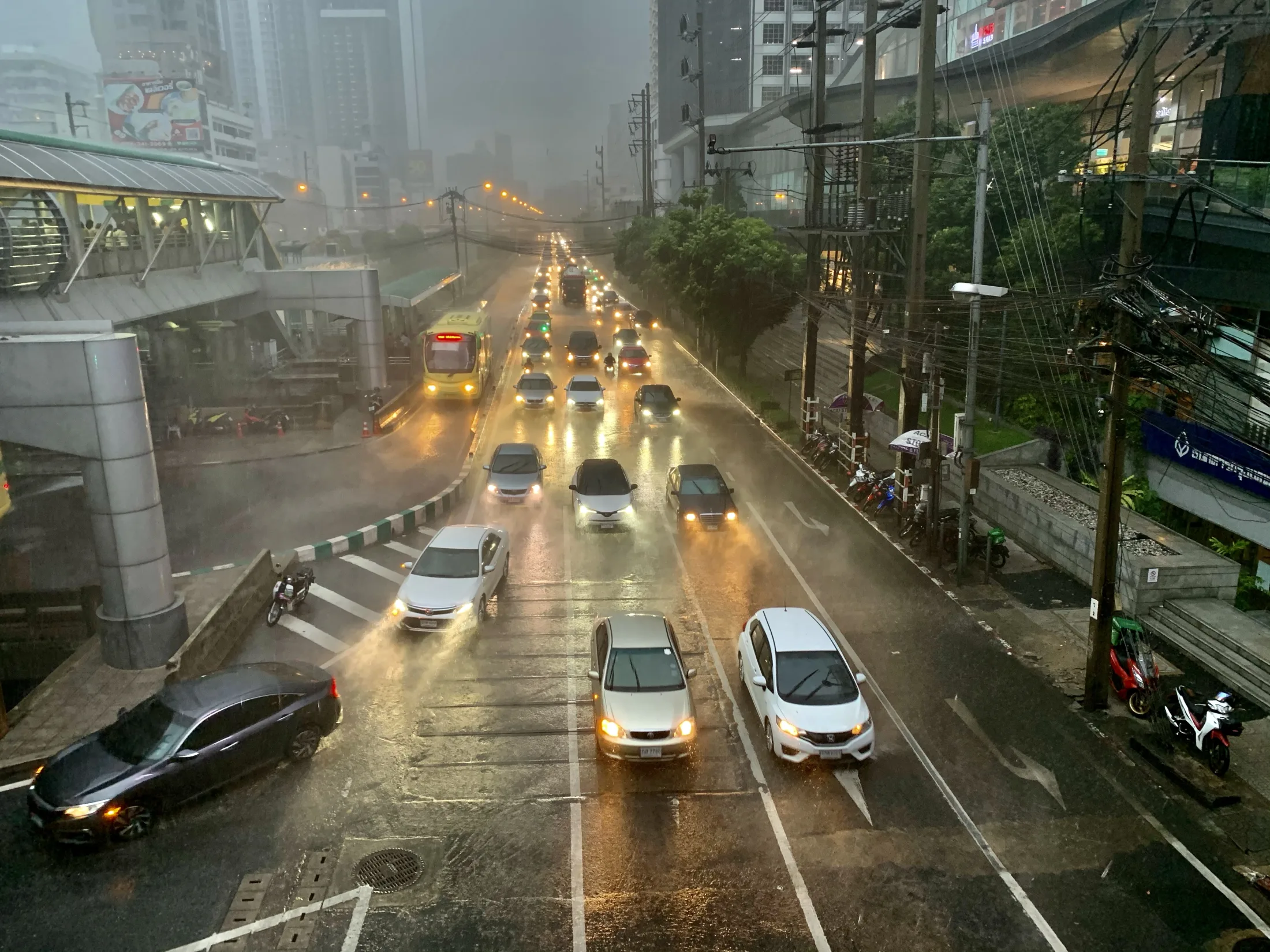
Rain is intense, local, and often badly timed
Bangkok rain often arrives as a hard burst rather than an all-day drizzle. One district can be soaked while another remains dry.
The most disruptive part may be the last kilometer:
- taxis become harder to book;
- motorcycle rides become less appealing;
- traffic slows;
- sidewalks collect water;
- station entrances crowd;
- delivery estimates expand;
- the final soi becomes difficult even when rail service is normal.
Keep a compact umbrella and footwear that tolerates water. Store electronics and documents in a water-resistant inner bag. Add time before airport trips and appointments during active storms.
Weather radar and official warnings are more useful than a generic phone icon that shows rain for the entire day.
Street flooding is a block-level question
Bangkok’s flooding risk cannot be summarized by district reputation alone.
Drainage differs by street. Elevation differs by building entrance. Construction changes water flow. A main road may drain while a connecting soi remains deep enough to stop a small car.
The Bangkok Metropolitan Administration’s Department of Drainage and Sewerage publishes annual flood-prevention plans, and the city maintains flood-monitoring and map resources. Those provide context. A prospective renter still needs current local evidence.
Ask the building manager, security staff, nearby shopkeepers, and residents:
- Where does water collect?
- How deep did it become during the worst recent storm?
- How long did it remain?
- Could normal cars reach the entrance?
- Did water enter the lobby, garage, electrical rooms, or lifts?
- Were deliveries and taxis able to enter?
- Does the building use pumps, barriers, or raised entrances?
- Has nearby construction changed drainage?
Look for water marks, repaired walls, rust, musty storage rooms, raised equipment, and portable barriers.
Basement parking deserves special attention. Ask where pumps and electrical systems sit and what happens during a power failure.
Inspect a neighborhood in rain
Sunshine hides drainage.
If possible, revisit a serious housing candidate during or immediately after a strong storm. Observe:
- the station exit;
- the walking route;
- the building entrance;
- garage ramps;
- pickup points;
- drainage grates;
- ground-floor shops;
- the nearest alternate route.
Do not enter moving or contaminated floodwater to test a street. Water can conceal holes, sharp objects, electrical hazards, and open drains.
Your goal is to understand access, not prove toughness.
PM2.5 affects real life
Fine particulate matter is small enough to penetrate deeply into the lungs and affect health. The World Health Organization links ambient air pollution to cardiovascular and respiratory disease, stroke, lung cancer, and other serious outcomes.
Bangkok air quality varies by day and area. Traffic, regional burning, weather, construction, and atmospheric conditions all contribute. Poor-air periods are often discussed as a dry-season problem, but daily readings matter more than folklore about one month.
Check Thailand’s official air-quality reporting through the Pollution Control Department’s Air4Thai service and compare nearby monitoring stations. Read the PM2.5 concentration and health guidance, not only the color shown by a third-party app.
People with asthma, cardiovascular disease, chronic lung disease, children, older adults, pregnant people, and anyone who reacts strongly to pollution should include air quality in the initial location and housing decision. Discuss personal precautions with a qualified clinician.
Evaluate the building envelope
A purifier cannot compensate for every building problem.
During a viewing:
- close the windows and balcony doors;
- listen for traffic and construction noise;
- check seals and visible gaps;
- smell for smoke or mold;
- ask whether corridors are open-air;
- identify kitchen and bathroom exhaust;
- inspect air-conditioner filters;
- check whether neighboring smoke enters;
- ask about renovation dust;
- learn the building’s filter and maintenance practices.
For a purifier, compare its clean-air delivery capacity with the actual room volume. Consider filter cost and local replacement availability. A small decorative unit in a large open-plan apartment may do very little.
Place the purifier where airflow is not blocked. Keep doors and windows closed during poor-air periods, and replace filters according to use and condition.
Exercise flexibly
Outdoor exercise is one of Bangkok’s pleasures when the conditions cooperate.
A resilient routine includes:
- a nearby park;
- an indoor gym or condominium fitness room;
- early-morning and evening options;
- access by rail or a short walk;
- a plan for rain;
- a plan for poor air.
Check heat, storms, and air quality before a long run. Move the workout indoors when conditions are poor. A park view is not the same as practical park access; test the crossing, entrance, opening hours, and route home after dark.
Mold, humidity, and the apartment
Humidity affects closets, bathrooms, leather, paper, electronics, and rooms that sit closed for long periods.
Inspect:
- silicone around showers and sinks;
- walls behind curtains and furniture;
- air-conditioner vents;
- wardrobes against exterior walls;
- ceilings below roof areas;
- cabinets under plumbing;
- rooms with weak sunlight or ventilation.
Musty odor deserves investigation. Fresh paint can conceal a recent leak. Ask what was repaired and request evidence when the issue appears material.
Use air conditioning, ventilation, moisture absorbers, or a dehumidifier as the apartment requires. Do not shut a damp room for weeks and expect the climate to negotiate.
Put climate into the monthly budget
Budget for:
- electricity during hot months;
- air-conditioner cleaning;
- purifier purchase and filters;
- ride-hailing during storms;
- water-resistant bags and shoes;
- indoor exercise;
- occasional delivery;
- maintenance caused by humidity;
- travel or schedule changes during poor-air periods.
A cheaper apartment can create higher transport, electricity, and air-quality costs. Compare the total routine.
The scouting-trip test
A short visit during the pleasant season can produce an incomplete answer.
Before committing long term, research:
- hot-season daytime walking;
- rainy-season access;
- recent flood history;
- dry-season air data;
- electricity use;
- indoor air and noise;
- backup transport;
- proximity to medical care.
You may still choose the same neighborhood. You will choose it with a realistic operating plan.
Bangkok’s climate is manageable for many people because the city offers air-conditioned transport, malls, delivery, good services, and homes across a wide range of designs. The fit improves when the building and ordinary week are chosen for the weather the city actually has.
Official sources
- Thai Meteorological Department: current Thailand and Bangkok weather
- Thai Meteorological Department: monthly climate summaries
- Bangkok Department of Drainage and Sewerage: flood-prevention plans
- Bangkok GIS flood-level map
- World Health Organization Thailand: air pollution
Forecasts, flood conditions, construction, and air quality change. Use current official data and inspect the exact building and route before committing.