Bangkok daily life · Practical precautions
Which Bangkok Hassles and Scams Should You Prepare For?
Confirm prices, recipients, property, contracts, and booking links. Stop when someone creates artificial urgency.
Reviewed July 31, 2026 · Later factual updates are dated within the guide
In this guide
Confirm fares and recipients, read bills and contracts, inspect property, keep records, and stop when someone creates artificial urgency.
Distinguish ordinary inconvenience, unclear terms, and deliberate fraud. Use proportionate precautions without assuming every problem is a scam.
Start by identifying the kind of problem
Bangkok friction falls into three broad groups:
| Type | Example | Practical response |
|---|---|---|
| Ordinary inconvenience | Traffic, rain, a driver declining a distant trip, a closed shop | Change the route, timing, or provider |
| Unclear transaction | No price stated, account changes, vague deposit terms | Stop and confirm in writing |
| Deliberate pressure or fraud | False closure, forced shopping stop, fake booking link, impersonation | Leave, preserve evidence, report when necessary |
Calling every inconvenience a scam makes you less accurate. Excusing every warning sign as a cultural misunderstanding makes you easier to exploit.
Taxi problems are usually solved before the door closes
Bangkok’s metered taxis remain useful, especially when rail does not reach the destination or several people are traveling together.
Common friction includes:
- a driver declining the destination;
- a request for a flat fare;
- an inactive meter;
- confusion over tolls;
- a route that looks unfamiliar;
- difficulty communicating the destination.
Show the destination in Thai when possible. Include the district, nearby landmark, and building phone number. Confirm the meter before the trip starts. Expressway tolls are normally additional to the metered fare, so clarify whether you want the expressway.
A refusal can be frustrating. Arguing through an open window rarely improves the trip. Choose another taxi, use an app, walk to a better pickup point, or switch to rail.
If a driver accepts the ride and then refuses to use the meter, leave before the vehicle moves when it is safe to do so.
Record the plate, vehicle color, time, pickup point, and receipt or app record if a serious problem occurs. Thailand’s government lists 1584 as the Department of Land Transport’s Public Passenger Protection Center. The Tourism Authority of Thailand also routes transportation complaints to that department.
For immediate tourist assistance, 1155 reaches the Tourist Police.
Use route awareness without accusing the driver
Bangkok routing is messy.
A driver may avoid an intersection, use a tollway, approach a building from the only usable entrance, or follow traffic information that differs from your map. GPS is evidence, not omniscience.
Before assuming you are being taken for a ride:
- Check whether the route avoids heavy traffic.
- Confirm the destination pin.
- Ask calmly where the driver is going.
- Compare the time estimate, not only the shape of the route.
- Use the app’s safety or support tools when the trip is booked digitally.
Escalate when the driver ignores a clear destination, disables the meter, demands an unexplained payment, behaves dangerously, or will not let you leave.
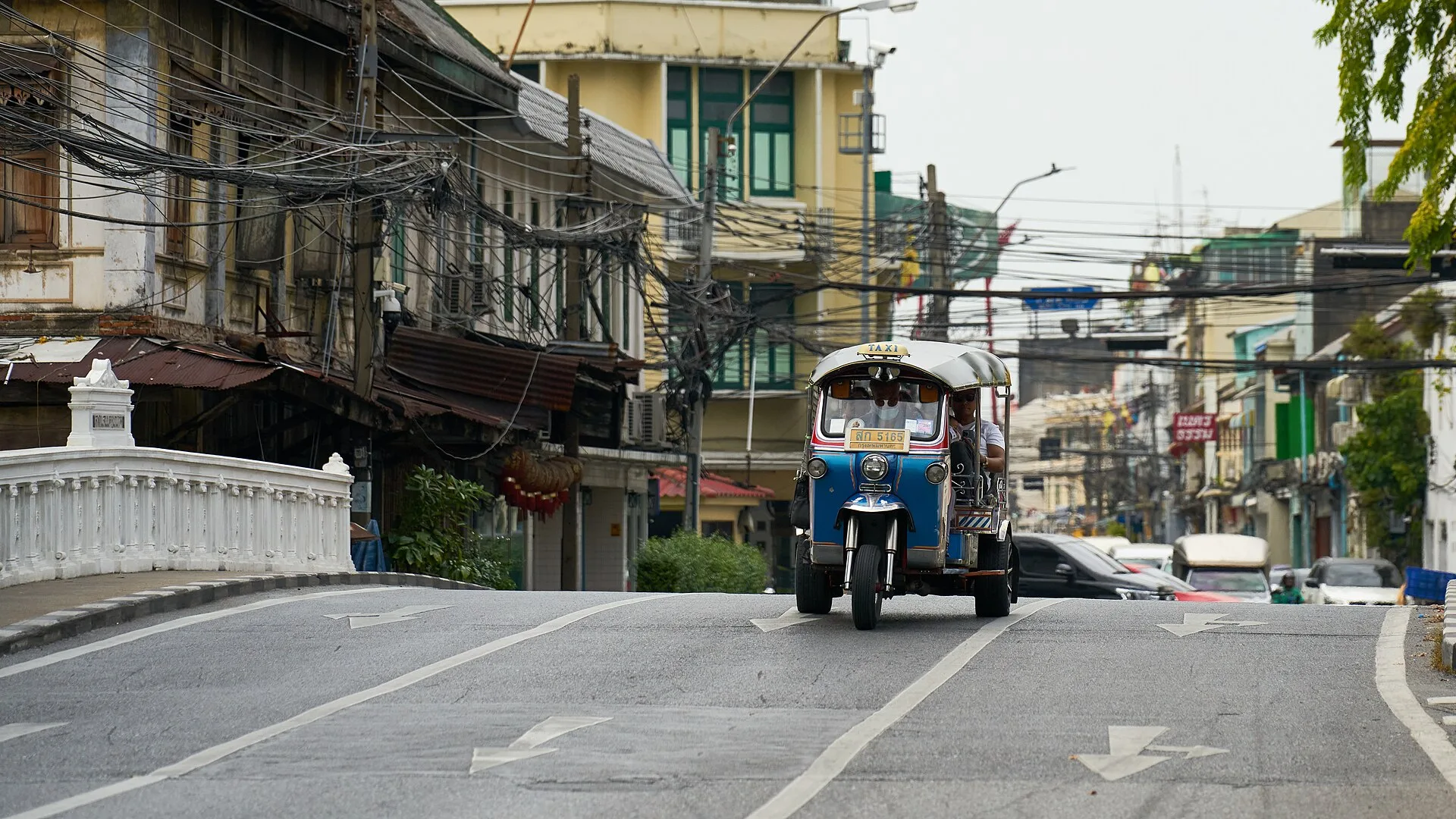
Tuk-tuks: agree on the trip, then enjoy it
Tuk-tuks are part of Bangkok’s character. They are also negotiated transport.
Before getting in, confirm:
- exact destination;
- total fare for the vehicle, not per person;
- whether the route is direct;
- no shopping, tailor, gem, or travel-agency stops;
- whether waiting is included.
The familiar commission detour begins with a cheap ride and an unexpected stop at a shop. The driver may receive fuel money or a commission for delivering visitors. You lose time and enter a sales environment you never requested.
Say clearly that you want a direct trip. If the explanation becomes complicated, choose another vehicle.
Another common approach is the “closed attraction” conversation. A stranger near a temple or landmark says the site is closed, restricted, or open only later, then offers an alternative tour.
Check the attraction’s official website, entrance, or uniformed staff. Religious ceremonies and official events can genuinely change access, so verify rather than confronting the person.
Tourist-area sales pressure
Bangkok has good tailors, jewelers, tour operators, markets, and small businesses. A legitimate business can still use aggressive sales tactics. A scam can also hide behind a polished storefront.
Slow down when you hear:
- today is the only day;
- the government is sponsoring the sale;
- export rules guarantee profit;
- the item can be resold at home for more;
- a stranger knows a secret wholesale location;
- your driver insists on one specific shop;
- payment must be immediate and nonrefundable.
Treat jewelry as a purchase for personal enjoyment, not a guaranteed investment. Treat tailoring as a custom service that requires fittings, fabric clarity, written price, and realistic delivery time.
Walk away when the business will not provide:
- full legal or trading name;
- itemized receipt;
- material description;
- refund or alteration terms;
- delivery date;
- card slip or traceable payment evidence.
Do not let embarrassment trap you. Leaving a sales pitch is free.
Verify accommodation and booking links
Fraud increasingly begins before arrival.
A convincing social-media account, copied listing, fake hotel page, or impersonated agent asks for a deposit by bank transfer. The photos may be real. The recipient may not be.
The Tourist Police Trust Portal now allows travelers to check verified accommodation providers, inspect suspicious URLs, and report scams. The portal also warns that verification does not make the Tourist Police a party to the contract or payment dispute.
Before paying:
- Contact the hotel or property through a phone number found independently.
- Compare the domain, email address, and recipient name.
- Check the cancellation and refund terms.
- Use a traceable payment route.
- Save the listing, messages, invoice, and confirmation.
- Be cautious when a booking moves abruptly from a known platform to private chat.
An attractive discount does not justify sending a large deposit to a personal account you cannot connect to the property.
Rental deposits and move-in condition
Long-term residents face a different set of problems from short-term visitors.
Deposit disputes often begin with weak documentation:
- the inventory is incomplete;
- existing damage was never photographed;
- utility balances were not recorded;
- the lease is unclear about cleaning or repainting;
- the agent disappears after move-in;
- the owner and agent give different instructions;
- the move-out inspection happens after the tenant leaves Thailand.
Before moving in:
- verify the owner or authorized lessor;
- read the lease before transferring the deposit;
- confirm the receiving account in writing;
- record every room in continuous video;
- photograph scratches, stains, chips, appliances, furniture, keys, and access cards;
- test air conditioning, hot water, drains, locks, lights, and appliances;
- photograph electricity and water meter readings;
- attach a signed inventory and condition record;
- document the deposit amount and return process.
Before moving out, request an inspection while you are still available to correct a legitimate issue. Record the final condition, meter readings, returned keys, and agreement about deductions.
Normal wear, repair responsibility, and deposit recovery can become legal questions. Obtain advice from a qualified Thai lawyer or consumer authority when the amount or dispute justifies it.
Sudden payment changes deserve a second channel
An email or chat message says the landlord changed banks. A vendor sends a new QR code. An agent says the owner needs the deposit tonight.
Pause.
Verify the change through a known phone number, face-to-face conversation, or established contact channel. Compare the displayed recipient name. Send a small test payment when practical.
Never trust urgency as proof.
Keep:
- original payment instructions;
- updated instructions;
- recipient name;
- bank or platform receipt;
- invoice;
- acknowledgment of what the payment covered.
This habit prevents fraud and innocent misapplication.
Card conversion and ATM prompts
Some payment terminals and ATMs offer to convert the transaction into your home currency. The screen may emphasize familiarity while hiding an unattractive exchange rate.
Read the prompt carefully. When your own bank or card provides the conversion, choosing Thai baht often avoids the merchant or ATM operator’s dynamic currency conversion. Your bank may still charge foreign transaction, cash-advance, or ATM fees.
Cover the keypad, secure the card before walking away, and inspect the ATM before use. Prefer machines in banks, malls, airports, or other well-managed locations.
If a machine retains your card, contact the bank using the official number displayed on the machine or the bank’s official website. Do not accept help from a stranger who asks for your PIN.
Nightlife bills
Most Bangkok bars and entertainment venues operate normally. Problems arise when prices, companions’ drinks, bottle terms, or service charges were never clear.
Before ordering in an unfamiliar venue:
- read the menu;
- ask about service charge and VAT;
- confirm bottle, mixer, table, and minimum-spend terms;
- check the bill during the evening;
- avoid leaving a card or passport as security;
- keep enough awareness to verify the final amount.
Do not sign a card slip with blank fields. Request an itemized bill. If the atmosphere becomes threatening, prioritize leaving safely and seek help rather than escalating a confrontation over the table.
Phones, bags, and crowded spaces
Bangkok is comfortable for everyday life, but dense stations, markets, festivals, and nightlife areas create opportunities for lost property and theft.
Use ordinary city habits:
- keep the phone away from the road edge;
- close bags on trains and escalators;
- do not leave a phone charging unattended;
- use a crossbody strap in crowds;
- keep a digital copy of the passport;
- store the physical passport securely when it is not required;
- enable device tracking and remote lock;
- keep bank and email recovery methods separate from the phone.
If property is stolen, preserve the location, time, device details, serial number, financial transactions, and any available camera information. Contact local police and the Tourist Police when appropriate.
What to do when something real happens
Separate inconvenience from danger.
For an uncomfortable price discussion, leave and choose another provider. For a documented consumer dispute, preserve evidence and contact the responsible agency. For immediate danger, injury, coercion, theft, or fraud, seek official help.
Useful official contacts:
| Need | Number |
|---|---|
| Tourist Police | 1155 |
| Police emergency | 191 |
| Medical emergency | 1669 |
| Department of Land Transport passenger complaints | 1584 |
| Tourism Authority of Thailand information | 1672 |
| Bangkok complaint and emergency service | 1555 |
The Tourist Police app also supports multilingual reporting, questions, and chat.
Save these numbers before you need them. A foreign SIM, roaming plan, backup battery, and local address written in Thai make an emergency easier to manage.
Keep perspective
Use routine verification without treating every interaction as suspicious.
Most drivers are doing a difficult job in heavy traffic. Most landlords want rent paid and the property treated well. Most shopkeepers quote a price, complete the transaction, and move on. Thai people routinely help newcomers navigate addresses, language, transport, and bureaucracy.
Clear fares, documented apartment condition, and verified payment instructions protect both parties.
Bangkok becomes easier when you learn where clarity matters.
Official help and verification
- Tourism Authority of Thailand: Tourist Police 1155
- Tourism Authority of Thailand: Tourist Police multilingual app
- Tourist Police Trust Portal
- Thailand government emergency-number directory
- Tourism Authority of Thailand complaint routing
Phone numbers and complaint channels can change. Confirm them through the responsible agency before relying on this guide for a future trip.
Last reviewed: July 31, 2026. Prices, phone numbers, complaint channels, and common scam methods change.