Work and immigration · Thailand
Can You Legally Work While Living in Thailand?
Your laptop does not become invisible to Thai law because the client is in Ohio.
Reviewed July 31, 2026 · Later factual updates are dated within the guide

In this guide
Foreigners who consult, manage a company, sell services, create sponsored content, run an online store, or perform other paid activity while in Thailand may have work-authorization and tax obligations. Payment into a foreign account does not by itself resolve those questions.
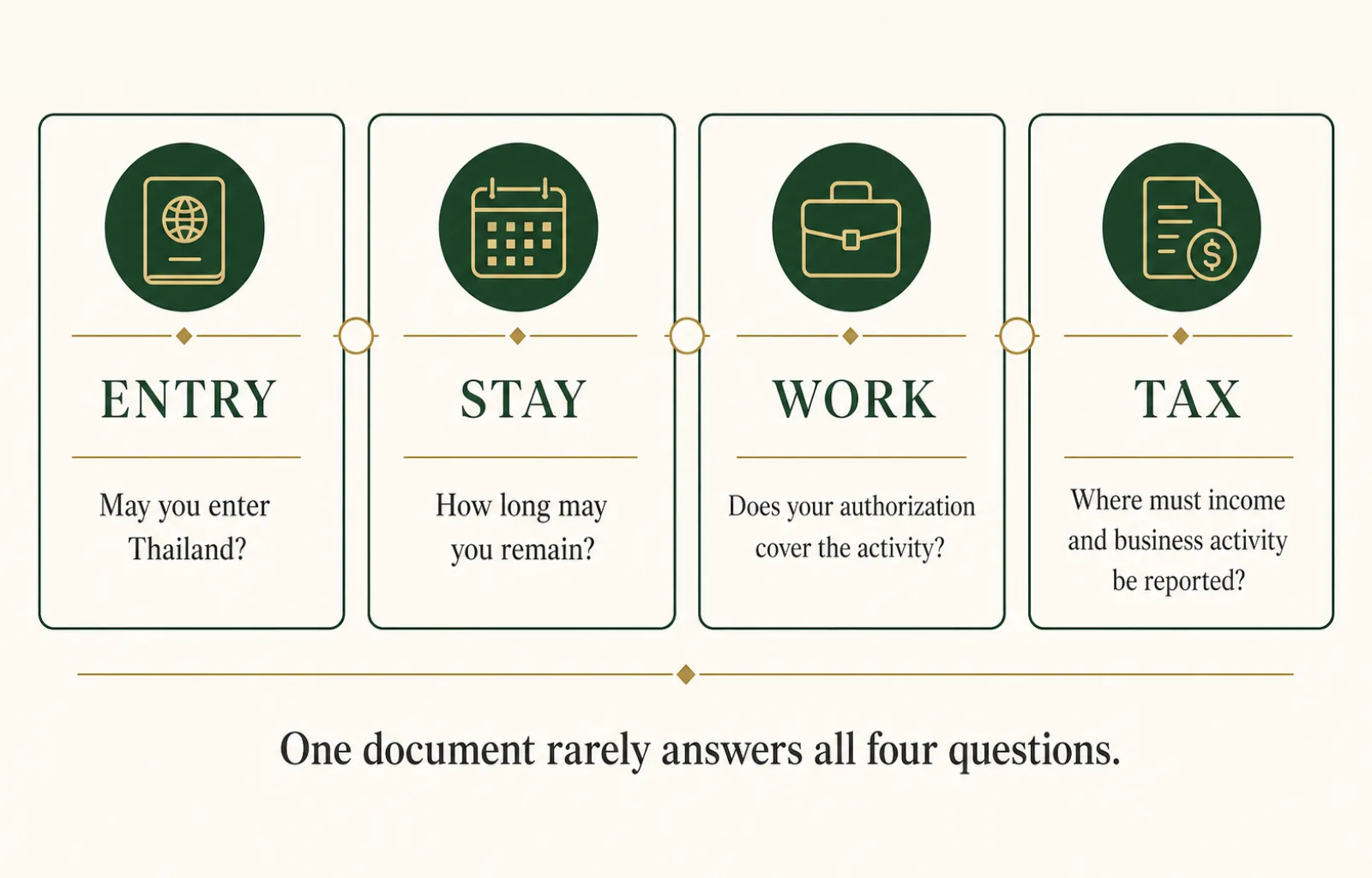
Thailand separates several questions that foreigners regularly mash into one:
- Are you allowed to enter?
- How long may you stay?
- Are you allowed to perform the work you actually do?
- Where and how is the income taxed?
A visa answers some of those questions. It does not automatically answer all of them.
This article expands Question 13 from 14 Questions to Ask Before Retiring or Living Long Term in Thailand.
Define the work you will actually perform
The description used informally—retired, digital nomad, volunteer, or hobbyist—does not determine the legal treatment of the activity.
Write down what you actually do:
- Thai employment
- work for a foreign employer
- freelance services
- consulting
- managing a company
- creating sponsored media
- selling products
- teaching
- volunteering
- speaking at events
- handling operations for a spouse’s business
- earning from content produced in Thailand.
Then ask which immigration, employment, licensing, and tax rules apply to that activity.
Describe the activity accurately before selecting an immigration route.
Immigration status and work permission are separate
Thailand’s Ministry of Labour and Board of Investment materials describe work permits as legal authorization tied to a foreigner’s permitted work, occupation, job description, and employer.
Traditional Thai employment commonly involves a non-immigrant status appropriate for business or employment, an eligible employer, and a work permit. Some promoted-company, Smart Visa, and Long-Term Resident arrangements operate differently.
A retirement visa or extension exists to support retirement. It should not be treated as a work permit with better branding.
A tourist entry is even clearer: Ministry of Labour guidance says tourists and transit travelers are not in the normal category eligible to apply for work permission.
Do not select a stay route until you have confirmed that it covers the activity you will perform.
“But my clients are overseas” is only one fact
Remote work creates genuine complexity.
The employer may be foreign. The client may be foreign. The contract may be signed abroad. The payment may enter a U.S. account.
You are still physically sitting in Thailand performing the activity.
That does not mean every remote worker has the same answer. Thailand has created routes that explicitly contemplate remote work, including the Destination Thailand Visa workcation category and the Long-Term Resident Work-From-Thailand Professional category.
It does mean “the money never enters Thailand” is not a complete work-authorization analysis.
Income location, work location, customer location, entity location, visa status, and tax residence are related. They are not interchangeable.
The DTV covers defined activities
Thailand’s official e-Visa system lists the Destination Thailand Visa for workcation and Thai soft-power activities.
That is materially better evidence than a Facebook group declaring that everyone with a laptop is now covered.
Eligibility, documentation, permitted stay, extension, and the applicant’s actual activities still matter. A person employed remotely by an overseas company is not identical to someone operating a Thai-facing business, hiring locally, selling to Thai customers, or performing an occupation restricted to foreigners.
The official portal proves that the visa category and workcation purpose exist. It does not explain every work-permit boundary for every business model. That distinction matters for Thai clients, Thai entities, local staff, sponsored media, and services performed in Thailand.
Use the official e-Visa portal and the Thai embassy or consulate responsible for your application. Describe the activity accurately. Save the documents supporting the category. For anything beyond straightforward overseas remote work, obtain advice that addresses both immigration status and Thailand’s foreign-worker rules.
Do not turn a legitimate visa route into a story it never promised.
The LTR Work-From-Thailand route is narrow on purpose
The Board of Investment’s Long-Term Resident program includes a Work-From-Thailand Professional category for remote workers employed by well-established overseas companies.
The qualification standards include employer and income requirements. BOI documentation may require an employment letter, employer evidence, remote-work permission, income records, and health-insurance or deposit evidence.
BOI also states that Work-From-Thailand Professional holders do not receive a Thai digital work permit for Thai employment because the category is designed around working remotely for an overseas employer.
That distinction matters.
A visa designed for foreign employment does not automatically authorize taking a job with a Thai entity.
Thai employment normally needs the Thai employment structure
For ordinary employment with a Thai company, the employer is part of the legal process.
The company may need to supply corporate, tax, employment, and staffing documents. The proposed occupation must be open to foreigners. The foreigner’s permission can be tied to the approved employer, position, and work.
Changing jobs, duties, or employers may require new approval.
This is why “I have a work permit” is not the end of the conversation. The important question is whether the permit covers what you are doing now.
The work performed should match the employer, role, and conditions stated in the authorization.
Some occupations are restricted
Thailand reserves certain occupations for Thai nationals or permits foreign participation only under conditions.
Do not assume that owning a company, marrying a Thai citizen, or obtaining a visa overrides occupational restrictions.
Before planning a business around work you personally intend to perform, confirm:
- whether the occupation is restricted
- whether a license is required
- whether the company qualifies to employ you
- whether the role and work location can be approved
- whether employees or capital requirements apply
- whether foreign-business restrictions affect the company.
Pay a qualified Thai professional to review the actual model. Internet confidence is cheapest just before it becomes expensive.
Company ownership and work authorization are separate
Owning shares and working in the business are separate acts.
A foreigner may invest in or own part of a company yet still need authorization to perform management, sales, service, or operational work.
Conversely, placing a company in a Thai friend’s or spouse’s name while the foreigner supplies the money and controls the business can create nominee and ownership risks.
Do not build a business around the sentence, “Everyone does it.”
Everyone also ignores the smoke alarm until one apartment catches fire.
Volunteering can still be work
Unpaid activity is not automatically outside work rules.
Teaching, helping an organization, working at an event, or providing skilled services may still require the proper status or authorization even when no salary is paid.
Reputable organizations should understand the requirements for foreign volunteers. If the organization responds to legal questions with “just say you are visiting,” you have learned something useful about the organization.
Good intentions do not issue permits.
Commercial content creation may require authorization
Posting vacation photos is not the same as operating a monetized media business.
If you film sponsored videos, negotiate deals, employ production help, sell guides, accept tourism benefits, or run a commercial publication from Thailand, consult qualified legal and tax professionals about those activities.
The fact that a camera is small does not make the business theoretical.
PlanWellAbroad’s own standard should be simple: document the work honestly, use the correct immigration and work structure, disclose commercial relationships, and obtain Thai advice before revenue-producing activity crosses into regulated work.
The site cannot warn readers against wishful thinking while operating on wishful thinking.
Work authorization and tax require separate analysis
You can have lawful permission to work and still misunderstand tax.
You can also owe tax without having proper work authorization.
Tax residence, Thai-source income, foreign-source income, remittances, treaty rules, social security, payroll, business presence, and U.S. worldwide filing obligations are separate analyses.
Americans remain subject to U.S. federal tax rules on worldwide income. Thailand’s tax treatment depends on Thai law and the person’s facts.
Do not ask an immigration agent to finish the tax analysis unless that person is also qualified to do so.
Use a four-document test
Before beginning, collect:
1. Immigration basis
What grants your entry and stay, for how long, and under what conditions?
2. Work basis
What specifically authorizes the activity, employer, occupation, and location?
3. Contract and entity record
Who employs or pays you? Where is the entity? Who receives the service? What documents prove the arrangement?
4. Tax memorandum
Where might income, payroll, business activity, reporting, and tax residence be recognized?
If the only document is a visa sticker and the rest is a story you tell yourself, keep working on the plan.
Questions to ask a Thai lawyer or qualified adviser
- Does my exact activity count as work in Thailand?
- Does my visa category contemplate this activity?
- Do I need a work permit or another authorization?
- Is the occupation restricted?
- Can I serve foreign clients from Thailand?
- Can I own and manage the proposed company?
- What may I do before approval is issued?
- What changes require new approval?
- Does volunteering require authorization?
- Could my activity create Thai tax, payroll, VAT, or permanent-establishment issues?
- What records should I retain?
Ask for the answer in writing. “The officer said it should be okay” has a short shelf life.
Basic compliance rule
Choose the legal structure around the work you truly intend to perform.
Do not choose a retirement route and quietly build a consulting practice.
Do not choose a remote-work route and quietly take Thai clients.
Do not form a company and assume ownership gives you permission to operate it.
And do not let someone sell you certainty when the official sources describe conditions.
Your laptop is portable. The law does not become portable with it.
Editorial disclaimer: General educational information. PlanWellAbroad does not provide individualized immigration, employment, business, licensing, legal, financial, or tax advice or guidance. Rules and implementation change; confirm your facts with responsible Thai authorities and qualified professionals before working.
Primary sources
- Thai Ministry of Labour: Labour law and foreign work permits
- Thai Ministry of Labour: Who may apply for work permission
- Thai Ministry of Labour: Occupations prohibited for foreign workers
- Thailand BOI: Work Permit Overview
- Thailand BOI/OSOS: Visa and work permit guidance
- Official Thai e-Visa portal and DTV category
- BOI Long-Term Resident program
- BOI LTR visa and work-permit issuance
- BOI 2026 LTR Work-From-Thailand criteria