Tax · Long-term Thailand
How May Thailand Tax Your Income After You Move?
Moving money is easy. Explaining what the money was three years later is the part nobody puts in the banking-app commercial.
Reviewed July 31, 2026 · Later factual updates are dated within the guide

In this guide
Tax treatment depends on residence days, income source, remittances, income category, domestic law, and any applicable treaty provision. Another resident’s filing history does not establish the rule for your circumstances.
For Americans living in Thailand, the analysis has several layers:
- Thailand may treat you as a tax resident once your annual day count reaches the statutory threshold.
- Thailand may tax Thai-source income.
- Foreign-source income brought into Thailand can raise Thai tax questions.
- The United States generally continues taxing citizens on worldwide income.
- The U.S.–Thailand treaty may affect which country taxes particular income and how double taxation is relieved.
- The result can differ for wages, consulting, pensions, Social Security, dividends, interest, capital gains, rent, and business income.
A useful analysis asks: What income did you receive? Where and when did it arise? When and how did you bring money into Thailand? What do Thai law, U.S. law, and the treaty do with those facts?
This article expands Question 5 from 14 Questions to Ask Before Retiring or Living Long Term in Thailand.
Start with the 180-day residence test
Section 41 of Thailand’s Revenue Code says a person staying in Thailand for an aggregate of 180 days or more in a tax year is deemed a resident. The Revenue Department’s current English filing guide uses the same “at least 180 days” standard.
Count days using travel records.
A retirement extension, DTV, LTR visa, work permit, lease, or condo title may be relevant to other questions. None replaces the Revenue Department’s day test.
Track entries and exits using passport records, flight confirmations, and an annual calendar.
You may still find an older Revenue Department summary page that says “more than 180 days.” The statute and current return guide say 180 days or more. Use the statutory threshold and have a Thai adviser confirm your count rather than betting the filing position on inconsistent website wording.
Thai-source income has its own rules
Thailand’s Revenue Code addresses income connected with employment or business carried on in Thailand, a Thai employer, or property situated in Thailand.
That means the analysis is not limited to money remitted from abroad after becoming a resident.
If you work while physically in Thailand, rent Thai property, operate a Thai business, or receive other Thai-source income, the source rules matter even if the money enters a foreign account.
“Paid in America” does not automatically mean “earned in America.”
The bank account tells you where money landed. It does not always tell you where the activity occurred or where the income arose.
Foreign-source income and remittances require records
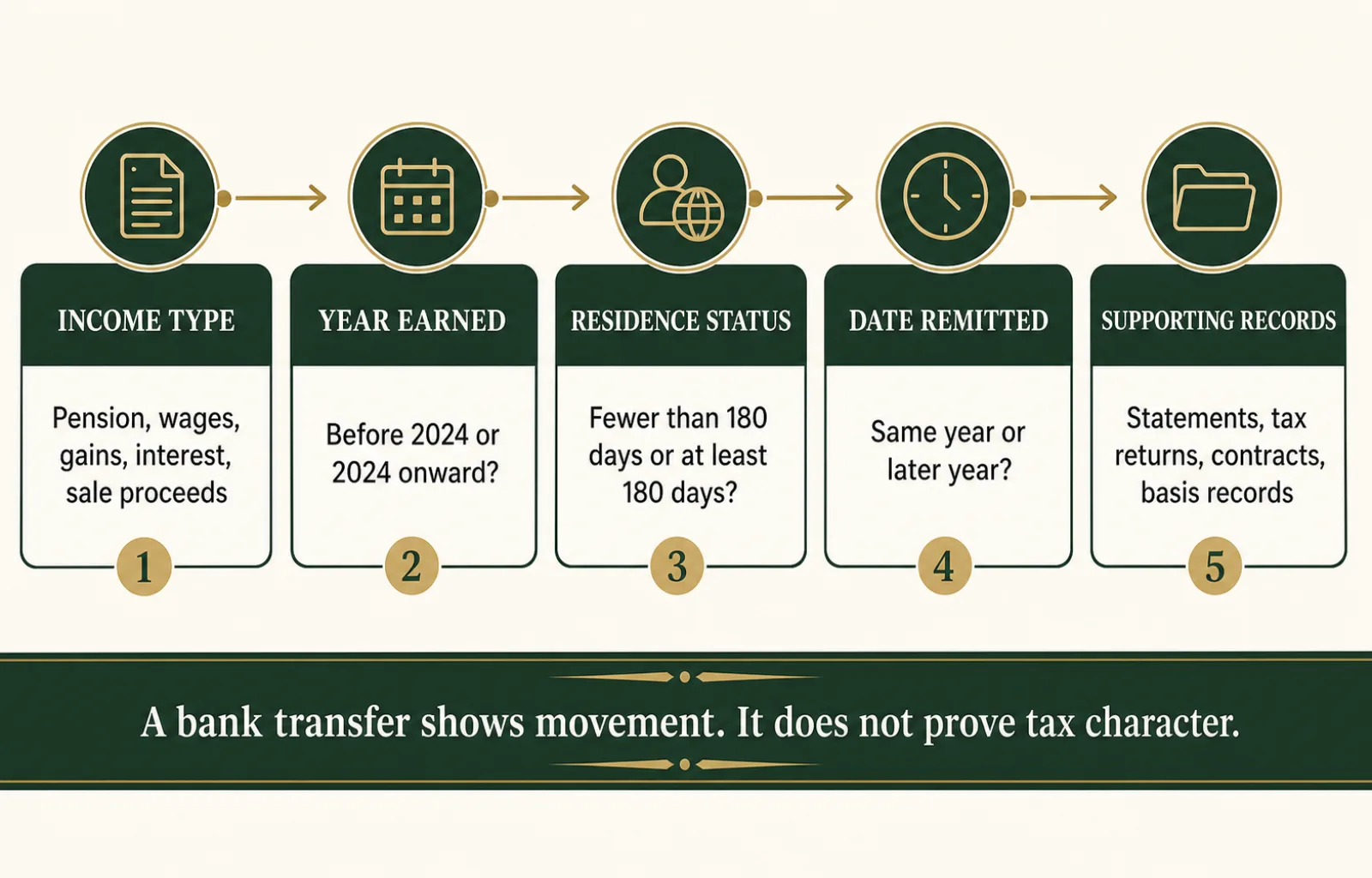
The Revenue Department’s English guidance for foreigners says foreign-source income is subject to Thai tax when two conditions are met: the income was earned on or after January 1, 2024 in a tax year when the person stayed in Thailand for at least 180 days, and that income was later remitted to Thailand, wholly or partly.
That short sentence creates long questions.
What counts as foreign-source income? When was it earned? Was the money later remitted? Was the transfer current income, old savings, sale proceeds, a loan, a gift, return of capital, or movement between your own accounts?
Bank statements show a transfer. They do not explain its tax character.
The same Revenue Department guide says foreign-source income earned before January 1, 2024 is not subject to Thai tax when remitted in a later year. It also says income earned in a year when the person was not a Thai tax resident is not brought into this rule merely because it is remitted later. Documentation is what separates those facts from a hopeful label.
If $50,000 moves from a U.S. account to Thailand, the receiving bank may see one deposit. Your tax file may need to distinguish:
- pension distributions
- Social Security
- dividends and interest
- realized investment gains
- wages or consulting income
- proceeds from selling an asset
- pre-existing savings
- loan proceeds
- a gift
- transfers between jointly owned accounts.
Do that classification when the evidence is fresh, not after receiving a question from an authority.
The word “savings” needs supporting records
Foreign residents often describe every transfer as savings.
Sometimes that is accurate. Sometimes the account contains salary, dividends, gains, pension distributions, and yesterday’s interest all swimming together.
The longer income and capital share one account, the harder it becomes to explain which money moved.
Consider maintaining clean source accounts or detailed transaction records. Preserve year-end statements, acquisition records, pension statements, tax returns, sale confirmations, loan documents, and transfer receipts.
Tax planning frequently fails not because the taxpayer chose the wrong theory, but because the taxpayer cannot prove the facts.
The transfer date is only one fact
Use the Revenue Code, current Revenue Department guidance, the applicable treaty, and records for the specific income.
The treatment of foreign-source income can depend on the year earned, the year received, the year remitted, residence status, income category, treaty provisions, credits, exemptions, and administrative guidance.
This area has changed and may change again.
Before making a large transfer, ask a qualified Thai tax professional to address:
- the source and category of the funds
- the year the income arose
- whether you were Thai resident that year
- whether and when the amount will be remitted
- available exemptions, deductions, or credits
- treaty treatment
- documentation required.
Do not send the money first and ask the tax question while it is clearing.
Americans still have a U.S. return
U.S. citizens generally remain subject to U.S. federal tax on worldwide income while living abroad.
Moving to Thailand does not convert a citizen into a nonresident alien for U.S. tax purposes. A foreign address does not cancel Form 1040.
Depending on the facts, an American abroad may also need to consider:
- foreign tax credits
- foreign earned income exclusion rules
- FBAR
- Form 8938
- self-employment tax
- foreign corporations or partnerships
- foreign trusts
- rental reporting
- state domicile and filing
- estimated tax
- information returns with large penalties.
The foreign earned income exclusion applies to qualifying earned income. It does not generally apply to pensions, Social Security, dividends, or capital gains.
What the treaty can actually do
The United States and Thailand have an income-tax treaty.
Treaties allocate taxing rights, define residence, address categories of income, and provide mechanisms intended to relieve double taxation. They also contain conditions, definitions, exceptions, and a U.S. saving clause that generally preserves the United States’ right to tax its citizens as though parts of the treaty did not exist.
Do not stop reading at the sentence that appears favorable.
For pensions and Social Security, Article 20 and the Treasury technical explanation are important. Government service has separate treatment. Business profits, employment, independent services, dividends, interest, gains, and property income have their own articles.
An IRA withdrawal, 401(k) distribution, private annuity, government pension, and Social Security benefit can receive different treatment. Classify each payment separately.
Double taxation relief usually needs a mechanism
The treaty’s relief article and domestic laws use foreign tax credits to address certain double taxation.
Credits are not always dollar-for-dollar in practice. Limitations, sourcing, timing, income categories, exchange rates, and whether the foreign tax was legally owed can matter.
Paying tax twice and hoping software fixes it is not the preferred workflow.
Map the income before filing:
| Income | Source | Paid into | Potential Thai treatment | Potential U.S. treatment | Treaty article | Credit evidence |
|---|---|---|---|---|---|---|
| Social Security | U.S. | U.S. account | Treaty says taxable only in the U.S.; confirm benefit classification | U.S. taxable under domestic rules | Article 20(2) | Benefit statement |
| Private pension | U.S. | U.S. account | Review residence and pension rules | U.S. citizen rules | Article 20 | 1099-R and plan record |
| Consulting | Services performed in Thailand | U.S. account | Thai-source/work issues may apply | Worldwide income/self-employment | Services/business articles | Contracts and work calendar |
| Dividends | U.S. investments | U.S. brokerage | Foreign-source/remittance analysis | U.S. taxable | Dividends article | 1099 and transfer trail |
The table cannot calculate the answer by itself. It gives the preparer the facts needed to begin.
Social Security needs treaty-specific review
Article 20 of the U.S.–Thailand treaty specifically addresses pensions and Social Security payments. Paragraph 2 says U.S. Social Security benefits paid to a resident of Thailand or a U.S. citizen are taxable only in the United States.
Americans should not rely on a generic article describing how “most treaties” treat Social Security. The Thailand treaty is the document that matters.
Still review:
- who received the benefit
- citizenship
- treaty residence
- the type of Social Security payment
- whether the payment is actually a Social Security benefit or another public payment
- Thai domestic treatment
- U.S. domestic treatment.
Do not apply language from another country’s treaty to the U.S.–Thailand treaty.
Working from Thailand adds another layer
Remote workers and business owners can have more than personal income-tax questions.
Activity in Thailand may raise work authorization, payroll, withholding, VAT, company, or permanent-establishment concerns. The client’s location and payment account do not decide all of these.
Someone can have:
- a valid visa but incorrect work authorization
- valid work authorization but unaddressed tax
- correct personal tax but a company problem
- U.S. compliance while missing Thai compliance.
Legal permission and tax payment are not interchangeable merit badges.
U.S. state tax may continue after a move
Leaving the United States does not automatically end state tax residence.
States use different domicile and statutory residence rules. A person may keep ties through a home, driver’s license, voter registration, spouse, dependents, mailing address, business, or intent to return.
Before moving, document the state-residency plan. Do not discover during tax season that “I live in Thailand now” was not the only fact your former state cares about.
Build a tax file before the first transfer
Keep:
- day count and travel calendar
- visa and immigration records
- Thai tax identification and filings
- U.S. federal and state returns
- U.S. and Thai bank statements
- monthly transfer ledger
- pension and Social Security statements
- brokerage statements and realized-gain reports
- property sale and basis records
- contracts and invoices
- loan and gift documents
- foreign tax receipts and assessments
- written professional advice.
Name files so a human can understand them.
`IMG_8472.jpg` is not a tax system.
Questions to answer before December
- Will I reach 180 days in Thailand?
- What income did I receive this year?
- Where did each item arise?
- What money did I bring into Thailand?
- Can I prove whether each transfer was income, capital, loan, gift, or prior savings?
- Did I perform services while physically in Thailand?
- Which treaty articles may apply?
- What Thai filings or payments may be due?
- What U.S. information returns may be due?
- Can foreign tax credits be aligned?
- Did I preserve state-tax ties I meant to end?
Some tax decisions need to be reviewed before year-end or before funds are transferred.
Practical next steps
Do not reduce the analysis to remittance timing alone.
Organize it around evidence.
Track days. Classify income. Preserve source documents. Record transfers. Read the treaty article that applies to the actual income. Coordinate Thai and U.S. advice before a large distribution, sale, business change, or remittance.
Keep evidence that explains the source, timing, and nature of each material transfer.
Last reviewed: July 31, 2026. Tax rules and administrative guidance change; verify current treatment for your facts.
Editorial disclaimer: General educational information, not individualized Thai or U.S. tax, legal, investment, or immigration advice. Tax law and administrative guidance change. Obtain advice for your facts before acting.
Primary sources
- Thai Revenue Department: Personal Income Tax
- Thai Revenue Code: Sections 38–64, including Section 41
- Thai Revenue Department: 2024 personal income-tax return guide
- Thai Revenue Department: How foreigners living in Thailand pay tax
- IRS: U.S.–Thailand income-tax treaty
- U.S. Treasury: Thailand treaty technical explanation
- IRS Publication 54: U.S. Citizens and Resident Aliens Abroad
- IRS: Foreign pension and annuity distributions